Workouts
Gym workout routine for beginners: a 3-day and a 4-day plan
 By Suraj Lama, head trainer, 11 years training members
Updated
In short
- New to the gym: do the 3-day full-body routine below for your first 8 to 12 weeks. Two workouts, A and B, alternated.
- Ready for more, or short sessions only: move to the 4-day upper/lower plan.
- Sets of 8 to 12 reps, 1 to 2 minutes rest. Add 2 to 10% weight when you beat your target by 1 to 2 reps (ACSM).
- Can only make 2 days a week? That still meets the WHO minimum for muscle-strengthening work.
The best gym workout routine for a beginner is three full-body sessions a week, alternating two workouts (A and B), with 2 to 3 sets of 8 to 12 reps per exercise. Do that for 8 to 12 weeks, adding weight in small steps. When you want more, move to a 4-day upper/lower plan. Both plans, with sets, reps, rest and a simple progression rule, are below.
Which gym workout plan should you pick?
Pick the plan that matches how many days you can really train, not the number you hope for.
| Your week | Plan | Why |
|---|---|---|
| 2 days | Workouts A and B from the 3-day plan, one each | Meets the WHO minimum of muscle-strengthening on 2 or more days a week. |
| 3 days | 3-day full body (A, B, A, then B, A, B) | Matches ACSM’s 2 to 3 days a week for beginners. Each muscle trained 3 days a week. |
| 4 days | 4-day upper/lower | ACSM suggests 3 to 4 days for intermediate lifters, about 6 months in. Shorter sessions, more total work. |
Most office workers in Kathmandu do best with 3 days. A 4-day plan that turns into 2 days in a busy month gets you less than a 3-day plan you keep.
Before you start: warm-up, rest and order
Warm-up (5 to 10 minutes). Easy cardio for 5 minutes, then a few bodyweight squats, arm circles and band pull-aparts. Do 1 or 2 light sets of your first exercise.
Rest between sets. For sets of 6 to 12 reps, ACSM suggests 1 to 2 minutes. Take the full 2 minutes on squats and presses.
Exercise order. ACSM’s rule: large muscle groups before small, multi-joint moves before single-joint ones. That is why squats come first and planks come last.
Picking a weight. Choose a load you could lift 2 more reps than the target. The first week should feel easy. That is fine.
The 3-day full-body routine (weeks 1 to 12)
Train on three non-consecutive days, for example Sunday, Tuesday and Thursday. Alternate A and B: week one is A, B, A; week two is B, A, B.
Workout A
| Exercise | Sets × reps | Rest | Note |
|---|---|---|---|
| Goblet squat | 3 × 8–12 | 2 min | Hold a dumbbell at your chest, sit between your heels. |
| Dumbbell bench press | 3 × 8–12 | 2 min | Elbows about 45° from your body. |
| Lat pulldown | 3 × 10–12 | 90 s | Bar to upper chest, elbows down. |
| Dumbbell Romanian deadlift | 2 × 10 | 90 s | Hips back, flat back, stop when it wants to round. |
| Plank | 2 × 20–40 s | 60 s | Straight line, glutes tight. |
Workout B
| Exercise | Sets × reps | Rest | Note |
|---|---|---|---|
| Leg press | 3 × 10–12 | 2 min | Lower until your knees reach about 90°, don’t lift your hips off the seat. |
| Seated cable row | 3 × 10–12 | 90 s | Handle to your belly button, squeeze. |
| Seated dumbbell shoulder press | 3 × 8–12 | 90 s | Back on the pad, press up and slightly in. |
| Walking lunge or split squat | 2 × 8 each leg | 90 s | Front heel down, upright chest. |
| Back extension | 2 × 12 | 60 s | Hinge at the hips, stop at a straight line. |
| Pallof press | 2 × 10 each side | 60 s | Don’t let your body turn. |
Each session takes about 45 to 55 minutes with the warm-up. For form cues on each move, see our guides to back exercises, the chest workout, the shoulder workout and gym exercises for abs.
The 4-day upper/lower routine (after 3 to 6 months)
Train Upper 1, Lower 1, rest, Upper 2, Lower 2, then two rest days. For example: Sunday, Monday, Wednesday, Thursday.
| Upper 1 | Sets × reps | Lower 1 | Sets × reps |
|---|---|---|---|
| Barbell or dumbbell bench press | 3 × 6–10 | Barbell back squat or goblet squat | 3 × 6–10 |
| Seated cable row | 3 × 8–12 | Romanian deadlift | 3 × 8–10 |
| Seated dumbbell shoulder press | 3 × 8–12 | Leg curl machine | 2 × 10–12 |
| Lat pulldown | 3 × 8–12 | Walking lunge | 2 × 8 each leg |
| Triceps pushdown | 2 × 10–15 | Calf raise | 3 × 10–15 |
| Dumbbell curl | 2 × 10–15 | Cable crunch | 3 × 10–15 |
| Upper 2 | Sets × reps | Lower 2 | Sets × reps |
|---|---|---|---|
| Incline dumbbell press | 3 × 8–12 | Leg press | 3 × 10–12 |
| One-arm dumbbell row | 3 × 8–12 each side | Hip thrust or glute bridge | 3 × 8–12 |
| Assisted pull-up | 3 × 6–10 | Leg extension | 2 × 12–15 |
| Dumbbell lateral raise | 3 × 12–15 | Back extension | 2 × 12 |
| Face pull | 2 × 12–15 | Side plank | 2 × 20–30 s each side |
| Cable fly | 2 × 12–15 | Hanging knee raise | 2 × 8–12 |
Each session takes about 50 to 60 minutes. You train each muscle twice a week with more sets than the 3-day plan. More weekly sets tend to bring more muscle: a 2017 meta-analysis found a graded dose-response between weekly sets and muscle growth. More only helps if you recover, so add sets slowly.
How to progress: when to add weight
This is the part most routines skip, and it is the part that makes them work.
The ACSM position stand gives the rule: when you can do 1 or 2 reps more than your target, add 2 to 10% to the load. In the gym, that works out as “double progression”:
- Start at the bottom of the rep range, for example 3 × 8.
- Each session, try to add a rep to one or more sets.
- When you hit the top of the range on every set (3 × 12), go up to the next dumbbell or plate.
- Drop back to 3 × 8 with the new weight and build up again.
Upper-body lifts and small muscles move up slowly. Legs usually move faster. Write every session down: exercise, weight, reps. Without a log you are guessing.
When progress stalls for 2 to 3 weeks in a row: check sleep and food first. If those are fine, drop back one or two weight steps for a week, then build up again. If you have done the 3-day plan for 3 months or more and stall often, switch to the 4-day plan.
Fitting the routine around Nepali life
- Festival weeks. During Dashain and Tihar, family, travel and food take over. Aim for 2 sessions, Workout A and Workout B. That keeps the habit, and 2 days still meets the WHO guideline.
- Winter mornings. Take the full 10-minute warm-up when the gym is cold.
- Office days. If you train after work, eat something light about 1 to 2 hours before, like a banana and some chiura, or a small plate of dal bhat at lunch.
- Exam or deadline weeks. Do 2 sets instead of 3. Keep the weight, cut the volume.
Cardio, food and sleep
Strength training is one half. The WHO also recommends 150 to 300 minutes a week of moderate aerobic activity, such as brisk walking. A 10 to 15 minute walk or cycle after weights, plus walking on rest days, covers a lot of that.
Muscle needs food. Our post on daily protein requirement explains how much, and the calorie calculator gives you a starting estimate. Sleep matters as much as either, and no routine makes up for 5 hours a night.
Common beginner routine mistakes
- Changing the plan every week. You need to repeat the same exercises to see if you are progressing. Stick with one plan for at least 8 weeks.
- Going to failure on every set. End most sets with 1 or 2 reps left.
- Skipping legs. Leg exercises are the hardest, and the most skipped. Keep them first in the session.
- Too many exercises. Five or six good ones beat ten rushed ones.
- No log. If you don’t write it down, you won’t know when to add weight.
- Copying an advanced split. A 6-day bodybuilder split is built for people with years of training and time to recover.
When to stop and see a professional
These plans are for healthy adults. If you have a heart condition, high blood pressure, diabetes, take regular medication or are pregnant, check with your doctor before you start.
Stop the session and see a doctor or physiotherapist if you get sharp or shooting pain, pain in a joint (rather than tired muscles), numbness or tingling, or pain that lasts more than a few days. Chest pain, dizziness or unusual breathlessness during exercise needs a doctor the same day.
Do you need a trainer to follow a routine?
Not always. Plenty of people learn these moves alone from a plan like this one and a light start.
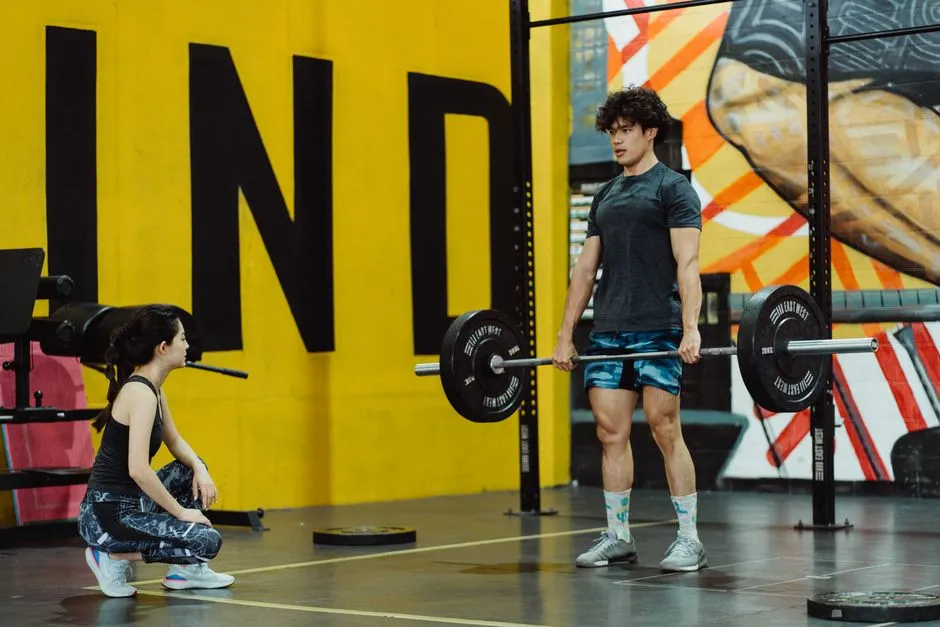
A trainer helps if you have never lifted, have an old injury, or have trained for months without progress. In a small 12-week study of 20 trained men, the group with a supervisor gained more squat and bench press strength than the group training alone. That is one study, but it fits what coaching is for: picking the right weights and keeping form honest.
If that sounds useful, you can train with a personal trainer to set up your plan and form, then carry on by yourself. For the why behind all of this, read our guide to strength training for beginners.
Want a plan built around this? Train with a personal trainer, or work out your numbers with the calorie calculator.
Sources
- ACSM: Progression models in resistance training for healthy adults, 2009
- WHO: 2020 guidelines on physical activity and sedentary behaviour (Bull et al., BJSM)
- Schoenfeld et al.: Dose-response of weekly training volume and muscle mass, J Sports Sci, 2017
- Mazzetti et al.: Supervised vs unsupervised resistance training, Med Sci Sports Exerc, 2000

Suraj Lama, head trainer. Suraj runs the training floor and writes the starter plan every new member leaves their free session with. Most of his members are office workers who train before 8 AM.
Published 29 October 2026 · Updated 29 October 2026