Workouts
Chest workout in the gym: 7 exercises and a beginner session
 By Arjun Thapa, strength trainer, 8 years training members
Updated
In short
- A complete beginner chest workout needs one flat press, one incline press and one fly or push-up. That is 3 exercises, about 40 minutes.
- Beginners: 2 to 3 sets of 8 to 12 reps, 1 to 2 minutes rest, chest on 2 days a week.
- Bench with safety bars set or a spotter, and add weight only when you beat your target reps. The full plan is in our gym workout routine.
A good chest workout in the gym for a beginner is three exercises: a flat press, an incline press and a fly or push-up. Do 2 to 3 sets of 8 to 12 reps each, twice a week. Below are 7 exercises to choose from, a 40-minute session, and how to bench safely when nobody is around to spot you.
Which chest exercises should a beginner pick?
Your chest muscle (the pec) fans out from your breastbone to your upper arm. Pressing straight out works most of it. Pressing on an incline puts more work on the upper part, near your collarbone.
Pick one exercise from each line:
- A flat press: dumbbell bench press, barbell bench press or chest press machine.
- An incline press: incline dumbbell press or incline machine.
- A finisher: cable fly, pec deck or push-ups.
That is all most people need for their first few months.
7 chest exercises in the gym, with sets and reps
The rep range follows the ACSM position stand on resistance training: loads you can lift 8 to 12 times for new lifters. End each set with 1 or 2 reps left in you.
| Exercise | What it works | Beginner sets × reps | Form cue |
|---|---|---|---|
| Dumbbell bench press | Whole chest, front shoulders, triceps | 3 × 8–12 | Elbows about 45° from your body, lower until the dumbbells are level with your chest. |
| Barbell bench press | Whole chest, front shoulders, triceps | 3 × 6–10 | Shoulder blades pinched, feet flat, bar touches the lower chest. Safety bars set. |
| Chest press machine | Whole chest | 3 × 10–12 | Handles at mid-chest height. Push out, don’t let your shoulders roll forward. |
| Incline dumbbell press | Upper chest, front shoulders | 3 × 8–12 | Bench at 30°, not higher, or it turns into a shoulder press. |
| Push-up | Chest, triceps, core | 2–3 × as many good reps as you can | Body in one straight line, chest to a fist’s height from the floor. Hands on a bench if needed. |
| Cable fly | Chest | 2 × 12–15 | Soft bend in the elbows, bring your hands together in a hugging arc. Light weight. |
| Pec deck | Chest | 2 × 12–15 | Seat so the handles are at chest height. Stop when your arms are level with your body. |
A sample chest session (about 40 minutes)
Rest 1 to 2 minutes between sets, in line with ACSM’s advice for 6 to 12 rep sets.
- Warm-up, 5 minutes. Easy cardio, 10 arm circles each way, 10 band pull-aparts, then 1 light set of your first press.
- Dumbbell bench press: 3 × 8–12.
- Incline dumbbell press: 3 × 8–12.
- Cable fly or pec deck: 2 × 12–15.
- Push-ups: 1 set, as many clean reps as you can.
Pair it with your back exercises on the same day. Pushing and pulling in one session keeps your shoulders balanced, and you leave with your whole upper body done.
How to bench press safely without a spotter
Gyms in the evening after office can get busy, and you won’t always find someone to spot you. You don’t need one if you set up right.
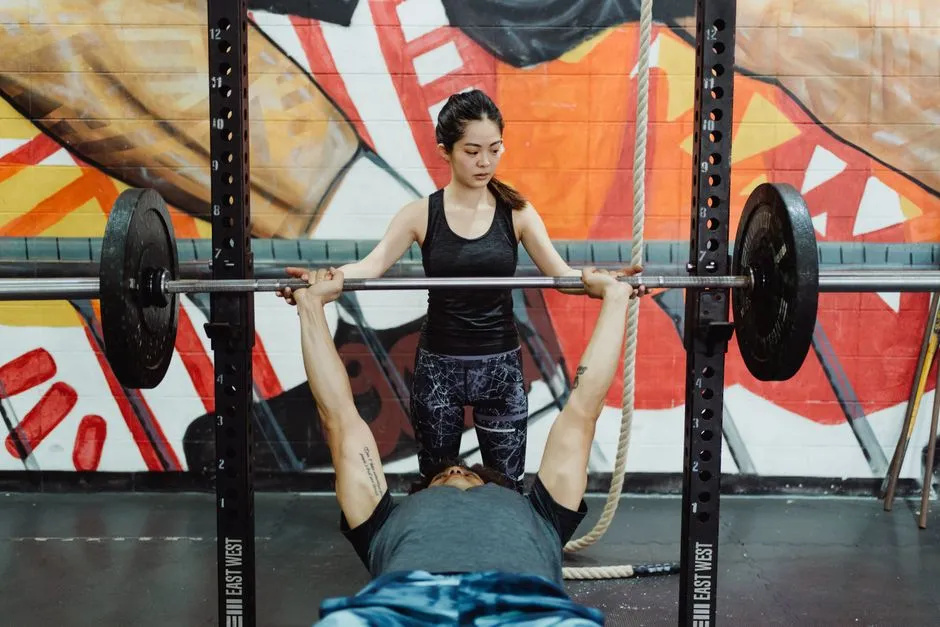
- Bench inside a rack with the safety bars set just below your chest at the bottom of the rep.
- No collars when alone. If you get stuck, tilt the bar and let the plates slide off one side, then the other.
- Use dumbbells on heavy days. A failed dumbbell rep ends with the dumbbells on the floor beside you, not on your chest.
- Stop 1 or 2 reps short of failure. The last rep you grind out isn’t the one that builds your chest.
If someone does spot you, tell them how many reps you plan and whether they should touch the bar.
Common chest workout mistakes
- Flaring elbows to 90°. It puts strain on the front of the shoulder. Tuck them to about 45°.
- Bouncing the bar off your chest. Lower under control, touch, press.
- Lifting your hips off the bench. It turns the press into a decline and hides weak reps.
- Half reps. Lower the weight until it reaches chest level. Short reps with a heavy weight build less muscle.
- Chest every day. Muscles grow between sessions. Twice a week is plenty for a beginner.
- Only chest, no back. Match every pressing set with a pulling set so your back gets as much work as your chest.
How to progress your chest workout
The ACSM rule is simple: when you can do 1 or 2 reps over your target, add 2 to 10% to the weight. On dumbbells, that usually means the next pair up.
Volume matters too. A 2017 meta-analysis by Schoenfeld and colleagues found a graded dose-response: more weekly sets, more muscle growth, with each extra set adding a little. For a beginner, start at 6 sets a week and add 1 or 2 sets every few weeks if you recover well.
When the chest day stops moving, put it into a structured plan. Our gym workout routine has a 3-day full-body plan and a 4-day upper/lower split. Your shoulders work hard on every press, so look at our shoulder workout before you add shoulder pressing on top.
When to stop and see a professional
These exercises are for healthy adults. If you have a heart condition, high blood pressure, diabetes, are pregnant or take regular medication, check with your doctor before you start lifting.
Stop and see a doctor or physiotherapist if you get:
- a sudden sharp pain or a pop in the chest or the front of the shoulder
- shoulder pain that is still there a few days later
- numbness or tingling down the arm
- chest pain, dizziness or unusual breathlessness (this needs a doctor that day)
Do you need a personal trainer for chest?
Most people don’t. A dumbbell press and a push-up are easy to learn from a guide and a mirror.
A trainer helps if your shoulders hurt when you press, you want to learn the barbell bench properly, or you have pressed the same weight for months. In that case, train with a personal trainer for a few sessions, then carry on alone. Pair the training with enough food: the calorie calculator gives you a starting estimate.
Want a plan built around this? Train with a personal trainer, or work out your numbers with the calorie calculator.
Sources

Arjun Thapa, strength trainer. Arjun coaches the squat, bench press and deadlift and checks the form of every new lift before it goes heavy.
Published 29 October 2026 · Updated 29 October 2026