Workouts
Gym exercises for abs: 8 moves that train your whole core
 By Suraj Lama, head trainer, 11 years training members
Updated
In short
- Train abs with one flexing move (cable crunch or hanging knee raise), one anti-movement hold (plank or Pallof press) and one side move (side plank).
- 2 to 3 sets each, 2 to 3 days a week, 15 to 20 minutes after your main workout.
- Ab exercises make your abs stronger. They don't remove the fat over them: in one study, 6 weeks of ab work changed belly fat no more than doing nothing.
- Back pain during ab work, or pain in a hernia or C-section scar: stop and see a doctor.
The best gym exercises for abs are the cable crunch, the hanging knee raise, the plank, the side plank and the Pallof press. Do three of them, 2 to 3 sets each, 2 to 3 days a week, at the end of your main workout. Below are 8 moves with sets and reps, a 20-minute ab workout, and the honest answer on belly fat.
Will ab exercises give you a flat stomach?
No, not on their own. Ab exercises make your ab muscles stronger and more visible underneath. They don’t remove the fat on top.
A small 2011 study in the Journal of Strength and Conditioning Research put 24 untrained adults on 7 ab exercises, 5 days a week, for 6 weeks, while keeping their diet the same. Their ab endurance improved. Their belly fat, waist size and body fat did not change compared with the group that did nothing.
So train abs for a strong core. Lose the fat over them with food, full-body training and patience. Our guide to belly fat exercises covers that side, and the calorie calculator gives you a starting number.
What your abs actually do
Your core is more than the six-pack muscle. It does three jobs:
- Bending forward (rectus abdominis): crunches and knee raises.
- Stopping movement (deep core, obliques): planks, Pallof presses, dead bugs. This is what protects your back when you lift.
- Twisting and bending sideways (obliques): side planks and cable rotations.
A good ab workout picks one move from each job.
8 gym exercises for abs, with sets and reps
For weighted moves like the cable crunch, use a load you can lift for 10 to 15 reps. For holds, stop when your form slips, not when the timer says so.
| Exercise | What it works | Beginner sets × reps | Form cue |
|---|---|---|---|
| Cable crunch (kneeling, rope) | Rectus abdominis | 3 × 10–15 | Hips stay still. Curl your ribs towards your hips; don’t just bow from the hips. |
| Hanging knee raise | Lower abs, hip flexors | 3 × 8–12 | No swinging. Curl your pelvis up at the top, lower slowly. Use the captain’s chair if grip fails. |
| Reverse crunch on a bench | Lower abs | 2–3 × 10–15 | Lift your hips off the bench by curling, not by kicking your legs. |
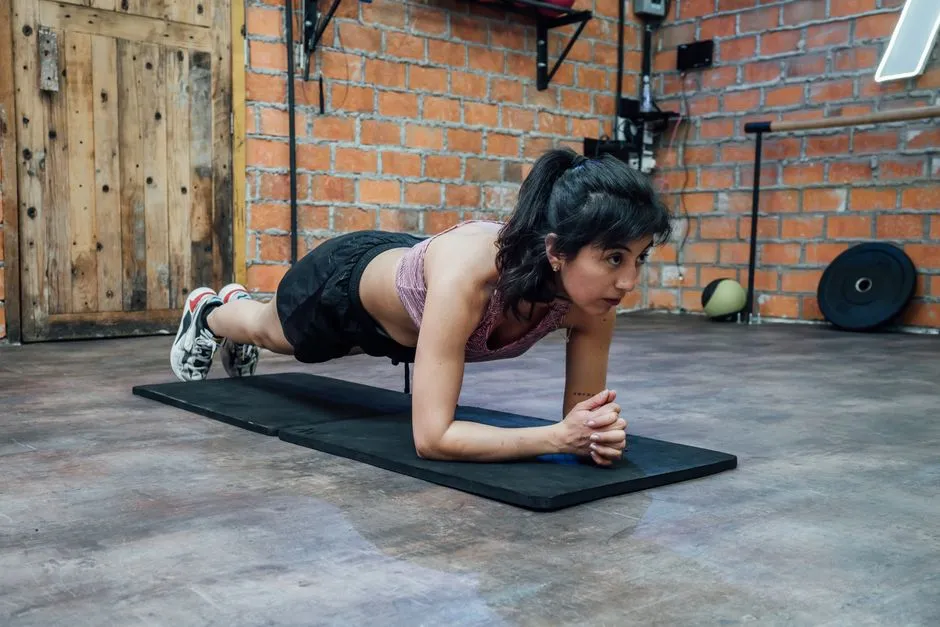
| Plank | Deep core, whole trunk | 3 × 20–40 s | Squeeze glutes, ribs down, a straight line from head to heels. |
| Side plank | Obliques | 2–3 × 15–30 s each side | Hips high, body in one line. Knees bent if needed. |
| Dead bug | Deep core | 2–3 × 8 each side | Lower back pressed to the floor the whole time. Slow. |
| Pallof press (cable) | Obliques, anti-rotation | 2–3 × 10 each side | Stand side-on to the cable, press out, don’t let your body turn. |
| Ab wheel rollout (from knees) | Whole front core | 2–3 × 6–10 | Roll out only as far as you can keep your back from sagging. |
A 20-minute ab workout for the gym
Do it after your main session, 2 to 3 days a week. Rest 45 to 60 seconds between sets.
- Cable crunch: 3 × 12.
- Hanging knee raise (or captain’s chair): 3 × 10.
- Pallof press: 2 × 10 each side.
- Side plank: 2 × 20 seconds each side.
- Plank: 2 holds, as long as your form stays clean.
Short on time after office? Do just three: cable crunch, Pallof press, plank. That covers all three jobs in about 10 minutes.
Ab work should sit inside a full plan, not replace it. Squats, rows and presses train your core too. See our gym workout routine for where abs fit in a week.
Common ab workout mistakes
- Hundreds of crunches. Past about 15 easy reps, you are training endurance, not strength (ACSM puts endurance work at more than 15 reps). Add weight (cable crunch) instead.
- Pulling on your neck. On floor crunches, hands lightly at your temples or crossed on your chest.
- Sagging planks. A 2-minute plank with your hips dropping trains your patience, not your core.
- Swinging on knee raises. Momentum does the lifting. Pause at the bottom of each rep.
- Only training the front. Skip obliques and anti-rotation work and you miss most of what keeps your back safe under a barbell.
- Holding your breath. Breathe out as you crunch or lift.
How to progress your ab workout
Abs follow the same rule as other muscles. The ACSM position stand suggests adding 2 to 10% to the load once you can do 1 or 2 reps more than your target.
- Cable crunch: when 3 × 15 feels steady, go up one plate on the stack.
- Knee raises: move to straighter legs, then to hanging leg raises.
- Planks and side planks: add 5 to 10 seconds a week, then move to harder versions, such as lifting one foot.
- Ab wheel: roll out a little further each week, as long as your back stays flat.
For how this fits into a full week, see our gym workout routine.
When to stop and see a professional
These exercises are for healthy adults. If you have a heart condition, high blood pressure, diabetes, take regular medication or are pregnant, check with your doctor before starting.
Stop and see a doctor or physiotherapist if:
- you feel pain in your lower back, rather than effort in your stomach
- you notice a bulge in your belly or groin when you strain (a possible hernia)
- you had a baby in the last year, or a C-section, and haven’t been cleared for core work
- you feel pain in a surgical scar
- you get dizzy or see spots during holds
After pregnancy, some women have a gap between the ab muscles. Ask a doctor or women’s health physiotherapist which core exercises are right before doing crunches or planks.
Who should get help with ab training
You don’t need a trainer to do a plank. This guide and a mirror are enough for most people.
A trainer helps when you have back pain, are coming back after pregnancy (once your doctor has cleared you), or want a full plan to lose fat and build strength together. That is when it is worth it to train with a personal trainer for a few sessions. Ab work also pairs well with your back exercises, since both protect the spine.
Want a plan built around this? Train with a personal trainer, or work out your numbers with the calorie calculator.
Sources

Suraj Lama, head trainer. Suraj runs the training floor and writes the starter plan every new member leaves their free session with. Most of his members are office workers who train before 8 AM.
Published 29 October 2026 · Updated 29 October 2026