Muscle gain
Weight gain diet plan: a 7-day Nepali week with calories and protein
 By Ritu Maharjan, nutrition coach, 5 years training members
Updated
Reviewed by: Qualified nutrition professional (to be named)
In short
- Eat about 10 to 20% more than you burn and aim to gain 0.25 to 0.5% of your body weight a week. For a 60 kg person that is 150 to 300 g a week.
- Dal bhat alone is low in protein (about 14 g a plate). Add eggs, dahi, paneer, chana, chicken or goat to most meals.
- The week below runs at about 2,300 to 2,700 kcal and 88 to 114 g protein. Get your own number from the calorie calculator and scale up.
- Train with weights 2 to 4 times a week, or most of the extra weight will be fat.
A weight gain diet plan is simple on paper: eat about 10 to 20% more calories than you burn, get enough protein, and lift weights so the extra goes to muscle rather than only fat. Most people who struggle to gain are not eating badly. They are eating too little, usually a normal plate of dal bhat twice a day with chiya in between.
Below is how big the surplus should be, how fast to gain, and a 7-day Nepali week with calories and protein for every day.
This is general guidance for healthy adults. If you have a medical condition, are under 18 or pregnant, see a doctor or hospital dietitian first.
How many extra calories do you need to gain weight?
A review of off-season bodybuilding research recommends a surplus of about 10 to 20% above maintenance, with a target gain of about 0.25 to 0.5% of body weight a week for beginners and intermediates (Iraki et al., 2019). The same review says people who have trained for years should be more careful, and suggests 200 to 300 kcal a day for highly trained athletes.
“Maintenance” (also called TDEE, total daily energy expenditure) is what you burn in a day, including work, walking and training. Our calorie calculator gives an estimate.
| If you maintain on | 10% surplus | 20% surplus |
|---|---|---|
| 2,200 kcal | 2,420 kcal | 2,640 kcal |
| 2,500 kcal | 2,750 kcal | 3,000 kcal |
| 2,800 kcal | 3,080 kcal | 3,360 kcal |
Start at 10%. Move to 20% only if the scale has not moved in three or four weeks.
How fast should you gain weight?
| Body weight | 0.25% a week | 0.5% a week | Over 12 weeks |
|---|---|---|---|
| 50 kg | 125 g | 250 g | 1.5 to 3 kg |
| 60 kg | 150 g | 300 g | 1.8 to 3.6 kg |
| 70 kg | 175 g | 350 g | 2.1 to 4.2 kg |
These are rates of weight, not muscle. Some of every gain is fat and water. Gaining faster than about 0.5% a week mostly adds fat, so be wary of any plan that promises “5 kg in a month”.
Why dal bhat alone is not enough
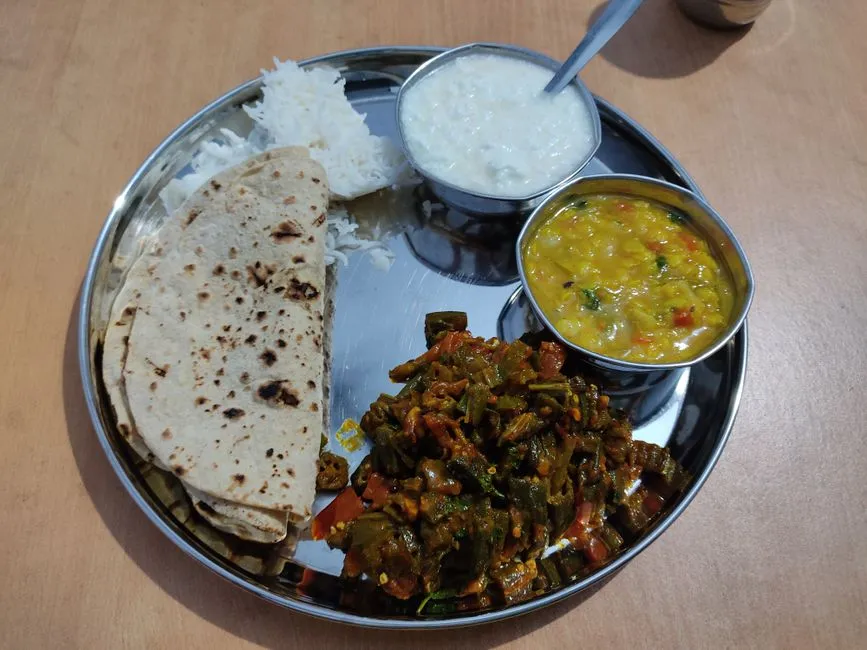
At typical portions (250 g rice, 150 g dal, 150 g tarkari), a plate of dal bhat tarkari gives about 487 kcal and 14 g protein, by our sums from the Nepal Food Composition Table (DFTQC 2012). Rice brings 322 kcal of that. Cooked dal is mostly water, so a katori gives only about 4.9 g protein.
That is why the fix is adding to the plate, not dropping rice:
- A second half plate of rice: about +161 kcal
- 1 tsp ghee: +45 kcal
- 2 boiled eggs: +148 kcal, +13.4 g protein
- 1 katori chana tarkari: +190 kcal, +8.9 g protein
- 50 g paneer: +166 kcal, +11.8 g protein
- 100 g chicken breast (raw weight): +168 kcal, +21.8 g protein
How much protein on a weight gain diet?
For people who train, the ISSN puts the range at 1.4 to 2.0 g of protein per kg of body weight a day (Jäger et al., 2017). For a 60 kg person that is 84 to 120 g. Our daily protein requirement guide has a full table of Nepali foods and two sample days.
A 7-day weight gain diet plan with Nepali meals
The week follows a normal Kathmandu day: chiya early, bhat in the morning, khaja in the afternoon, a second meal in the evening, milk or dahi before bed. All numbers are our sums from DFTQC 2012 and the Indian Food Composition Tables 2017. Portion weights are our assumptions, not measured plates, and the tables themselves carry about ±10% error. Meat is counted at raw weight without cooking oil, so a curry will be higher. Treat each total as “about”.
| Day | Early | Morning meal | Khaja | Evening meal | Before bed | Total |
|---|---|---|---|---|---|---|
| Sun | Chiya, banana, 30 g badam | Dal bhat tarkari, 1 tsp ghee, 2 eggs, extra half plate rice | 100 g chiura, 200 g dahi | Dal bhat tarkari, 1 tsp ghee, 100 g chicken | Glass of cow milk | 2,535 kcal, 98 g protein |
| Mon | Chiya, 2 roti, 2 eggs | Dal bhat tarkari, ghee, chana tarkari, extra rice | Plate of buff momo | 3 roti, dal, tarkari, 50 g paneer | Glass of cow milk | 2,576 kcal, 114 g protein |
| Tue (veg) | Chiya, banana, 30 g badam | Dal bhat tarkari, ghee, 200 g dahi, extra rice | 30 g roasted bhatmas, 50 g chiura, chiya | Dal bhat tarkari, ghee, 30 g Nutrela (dry weight) | Glass of buffalo milk | 2,435 kcal, 88 g protein |
| Wed | Glass of cow milk, 50 g chiura, banana | Dal bhat tarkari, ghee, 2 eggs, extra rice | Boiled sakarkhand, 30 g badam, chiya | Dhindo, dal, tarkari, 100 g goat meat | 200 g dahi | 2,394 kcal, 97 g protein |
| Thu | Chiya, 2 roti, 2 eggs | Dal bhat tarkari, ghee, 100 g chicken, extra rice | Plate of chicken momo | 3 roti, dal, tarkari | Glass of cow milk | 2,365 kcal, 110 g protein |
| Fri (veg) | Glass of cow milk, banana, 30 g badam | Dal bhat tarkari, ghee, 50 g paneer, extra rice | 50 g chiura, 200 g dahi, 1 tbsp til | Dal bhat tarkari, ghee, chana tarkari | Glass of buffalo milk | 2,681 kcal, 93 g protein |
| Sat | Chiya, banana | Dal bhat tarkari, ghee, 100 g goat meat, extra rice | 100 g chiura, 200 g dahi, 30 g bhatmas | 3 roti, dal, tarkari, 2 eggs | Glass of cow milk | 2,331 kcal, 103 g protein |
Portions used: rice 250 g a plate (extra = 125 g), dal 150 g a katori, tarkari 150 g, roti 40 g each, momo 250 g a plate (10 pieces), milk 250 g a glass, dahi 200 g a bowl, chiya with 50 g milk and 10 g sugar.
If your number is higher than the week
The week sits at about 2,300 to 2,700 kcal. If your calculator target is 3,000 kcal, add 300 to 600 kcal from this list each day:
- 30 g badam: 171 kcal
- A glass of buffalo milk instead of cow milk: +94 kcal
- 1 tsp ghee on each bhat meal: 45 kcal each
- A second half plate of rice: 161 kcal
- A banana and 30 g chaku in winter: 230 kcal
More food ideas, with a calorie table, are in weight gain foods.
Budget-friendly foods that add calories
In Kathmandu the cheapest calories are the ones you already buy: rice, chiura, roti, dal, potatoes, bananas, milk, dahi and peanuts. Per 100 g, roasted badam gives 570 kcal, chiura 346 kcal and dry soybean 411 kcal (DFTQC 2012). Eggs and Nutrela are the cheapest protein for most households. Paneer, chicken and goat cost more, so use them where they matter most: the meal after training.
Training with a weight gain diet
Eating more without lifting adds weight, but most of it will not be muscle. Lift 2 to 4 times a week with a full-body or upper/lower plan, and add a little weight or a rep each week. Our strength training guide has a beginner plan.
If you want someone to set the weights and check your intake every few weeks, that is what our personal trainer sessions for building muscle do. If you already train well and only need to eat more, you do not need us. The table above and a kitchen scale will do the job.
Common mistakes on a weight gain diet
| Mistake | What to do instead |
|---|---|
| Eating big for two days, then forgetting | Same meals most days; repeat the week |
| Skipping khaja at the office | Pack chiura, badam and a banana |
| Filling up on chiya and biscuits | Swap one cup for a glass of milk |
| Weighing every day and panicking | Weigh once a week, judge over 4 weeks |
| Cardio every day | Keep some walking; put the effort into lifting |
| Festival binge, then nothing | Dashain and Tihar are fine; get back to the plan the week after |
When to see a doctor first
See a doctor before a weight gain diet if you are losing weight without trying, your BMI is below 18.5 (the WHO’s “underweight” cut-off, WHO Europe), you have diabetes, a thyroid condition or a digestive problem, or you have a history of an eating disorder. Being thin for no clear reason is worth a check-up before it is worth a diet.
Want a plan built around this? Build muscle with a trainer, or work out your numbers with the calorie calculator.
Sources

Ritu Maharjan, nutrition coach. Ritu turns a member’s goal into meals that fit dal bhat, office canteens and family festivals. Medical diets go to a doctor.
Published 29 October 2026 · Updated 29 October 2026 · Reviewed by Qualified nutrition professional (to be named)