Recovery & classes
Kickboxing: how it compares with boxing, and what a first class is like
 By Nima Rai, boxing coach, 9 years training members
Updated
In short
- Kickboxing mixes boxing punches with kicks. Boxing uses punches only. Muay Thai adds elbows, knees and clinching.
- As a fitness class, all three are hard interval training with a skill to learn. Sparring is optional and should come much later.
- We teach boxing. For kickboxing or Muay Thai, ask at the desk. See boxing classes.
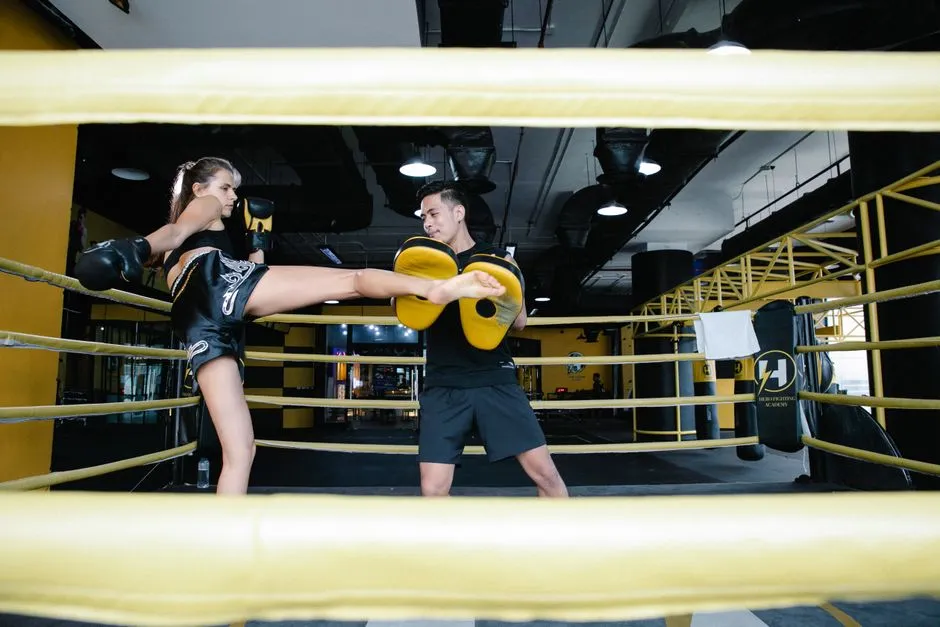
Kickboxing is a combat sport and workout that mixes boxing punches with kicks. Boxing uses only the fists, and Muay Thai adds elbows, knees and clinching. As a fitness class, all three are hard rounds of pad and bag work with rest in between, so they build fitness while you learn a skill. Here is how they compare, what a first class is like, and how to choose.
Boxing vs kickboxing vs Muay Thai
| Boxing | Kickboxing | Muay Thai | |
|---|---|---|---|
| What you strike with | Fists only | Fists and legs (kicks) | Fists, elbows, knees, shins |
| Clinch (holding and striking up close) | Broken up by the referee | Limited, depends on the rules | A big part of the sport |
| What you learn first | Stance, footwork, jab, cross, hook, uppercut | The boxing basics plus front and round kicks | Stance, kicks, knees, then punches and clinch |
| Main fitness demand | Shoulders, core, footwork, cardio | Whole body, hips and legs | Whole body, plus neck and core in the clinch |
| Shoes | Boxing shoes or flat trainers | Usually barefoot on mats | Barefoot on mats |
| Best first pick if | You want a simple skill to get good at fast | You want to kick as well as punch | You want the full stand-up toolkit and don’t mind more contact |
“Kickboxing” covers several rule sets. Some allow knees, some do not, and some fitness classes leave out all contact. Ask a gym what their class actually includes.
What happens in your first class
- Warm-up: skipping, shadowboxing.
- Stance and guard: hands by your cheeks, chin down.
- Basic strikes: jab, cross, then a simple kick, shown slowly.
- Pad or bag rounds: hard rounds with short rests.
- Conditioning: push-ups, squats, core.
- Cool-down: stretch the hips and hamstrings.
Expect your shoulders to burn from holding your hands up, and your calves to ache the next day. Nobody expects a beginner to kick high. A kick to the thigh or the bag’s middle is correct.
The fitness you get
A class like this is interval training in disguise: hard rounds, short rests, repeated. It is similar to the HIIT idea, with a skill on top.
A 2017 review found that kickboxers have moderate to high aerobic fitness and high anaerobic power, the ability to produce hard efforts over short periods (Slimani et al., 2017). That review looked at competitive athletes, not people in a fitness class, but it shows what the training builds.
WHO advises adults to do 150 to 300 minutes of moderate activity a week, or 75 to 150 minutes of vigorous activity, plus muscle-strengthening work on 2 or more days (WHO 2020 guidelines). Hard pad rounds count as vigorous. Two classes a week and two strength training sessions cover a lot of that.
For fat loss, classes help, but food decides most of it. Use the calorie calculator to see roughly what you burn in a day.
Basic techniques you will learn
| Technique | What it is |
|---|---|
| Jab | A quick straight punch with the front hand |
| Cross | A straight punch with the back hand, turning the hips |
| Hook | A short, bent-arm punch from the side |
| Front kick (teep) | A push with the sole of the front or back foot |
| Round kick | A swinging kick with the shin, turning the standing foot |
| Knee | A strike with the knee, used in Muay Thai and some rule sets |
Most classes drill two or three of these at a time, then join them into short combinations such as jab, cross, round kick.
Is it safe?
Fitness classes with pads and bags are low-contact. Sparring and competition are not.
- Head impacts. The same 2017 review links competition to repeated head trauma and traumatic brain injury (Slimani et al., 2017). If you never want to be hit in the head, say so, and stick to pad and bag work.
- Children and teenagers. The American Academy of Pediatrics and the Canadian Paediatric Society oppose boxing as a sport for children and adolescents, and name concussion as one of the most common boxing injuries (AAP and CPS, 2011). Parents: ask whether a youth class includes any head contact.
- Wrists and hands. Wrap your hands and keep your wrist straight when you punch.
- Knees and hips. Turn the standing foot when you throw a round kick. Kicking with a locked foot twists the knee.
- See a doctor first if you have had a concussion, have a heart condition or high blood pressure, or have a joint injury that is still healing.
Gear you need
- Hand wraps. Your own, because they get sweaty. Ask the coach to show you how to wrap.
- Gloves. Many gyms lend them at first. Before you buy, ask the coach which weight suits your size and the class.
- Clothes. Shorts or track pants you can lift your knee in, and a T-shirt.
- Shin guards and a mouthguard. Only needed once partner drills or sparring start.
- Water and a towel. Kathmandu summers before the monsoon make a gym very warm.
How to choose a class
Before you pay anywhere in Kathmandu, ask:
- What does the class actually include? Pad work only, or partner drills and sparring?
- Is sparring optional? It should be.
- Who coaches it, and how many people are in a class? A coach watching too many people cannot correct your technique.
- Can I watch or try one class first?
- What gear do I need to buy, and when?
Pick boxing if you want fewer techniques and faster progress. Pick a kicking style if you want to kick, and you are happy with more to learn. If you want a lighter, music-led workout with no contact at all, a Zumba class may suit you better.
Kickboxing near me in New Baneshwor
We teach boxing at Vajra Athletic Club. If you are looking for kickboxing or Muay Thai, ask at the desk whether any sessions are running. Class details and how to start are on the boxing classes page.
Want a plan built around this? Boxing classes, or work out your numbers with the calorie calculator.
Sources
- Slimani et al., Biology of Sport: Kickboxing review, anthropometric, psychophysiological and activity profiles and injury epidemiology, 2017
- AAP and Canadian Paediatric Society, Pediatrics: Boxing participation by children and adolescents, 2011
- Bull et al., BJSM: WHO 2020 guidelines on physical activity and sedentary behaviour, 2020

Nima Rai, boxing coach. Nima coaches boxing: footwork, pad work and bag rounds, fundamentals first. Sparring is only ever by choice.
Published 29 October 2026 · Updated 29 October 2026